
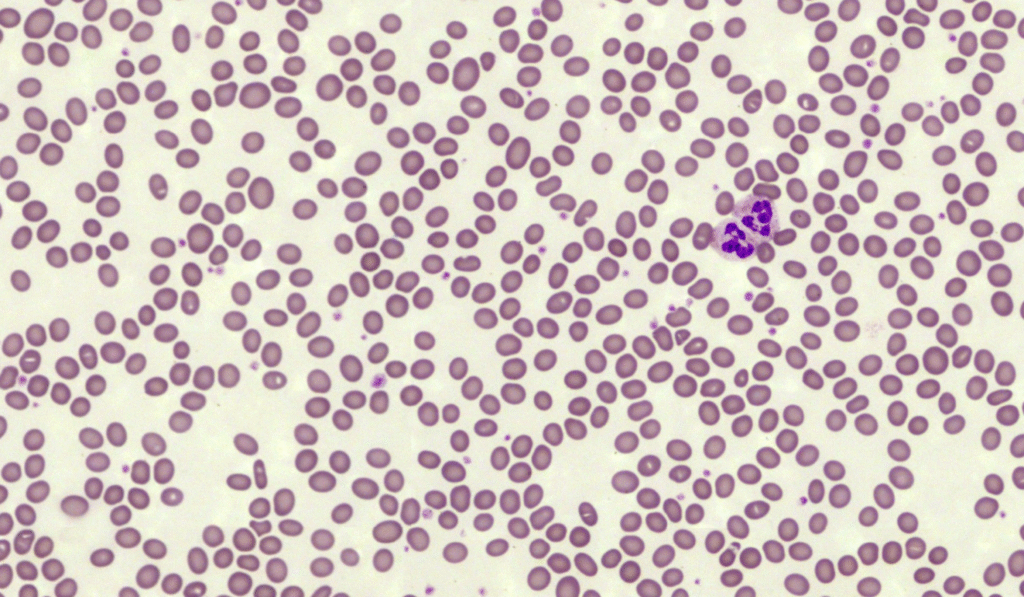
Our patient presented with a normal haemoglobin level but triggered multiple analyser flags, including spurious macrocytosis and fragment flags. These alerts occurred because the red cells were too rigid to deform normally through the analyser’s apertures, leading the machine to misinterpret their volume and shape. Upon film review, the red cells showed a striking, near-uniform population of large, oval cells.
The Diagnosis: Southeast Asian Ovalocytosis
Southeast Asian ovalocytosis is a common hereditary red cell membrane disorder in parts of Southeast Asia, particularly in Malaysia, Papua New Guinea, and the Philippines. Unlike other forms of elliptocytosis, these cells are exceptionally rigid.
In this particular case, the film was dominated by macro-ovalocytes; large, egg-shaped red cells. It is important to note that while this case features macro-ovalocytes, Southeast Asian ovalocytosis morphology can be variable; patients often also present with stomatocytic ovalocytes, which are elongated cells containing one or two characteristic transverse slits or “bars” across the centre. Regardless of the specific shape, their rigidity is their defining characteristic. They are so stiff that they cannot be easily deformed during laboratory testing.
The condition is caused by a specific heterozygous 27-nucleotide deletion in the SLC4A1 gene, which encodes Band 3, the major anion transport protein of the red cell membrane. This mutation causes the Band 3 proteins to aggregate into rigid clusters, effectively “locking” the membrane skeleton and preventing the cell from changing shape.
Southeast Asian ovalocytosis has been naturally selected because it provides significant protection against cerebral malaria caused by Plasmodium falciparum. The extreme rigidity of the SAO red cell membrane makes it very difficult for the parasite to invade the cell. Furthermore, even when infected, these rigid cells do not adhere as easily to the lining of small blood vessels (sequestration), which is the primary cause of life-threatening complications in malaria.
Key takeaway:
In the modern lab, Southeast Asian ovalocytosis is often an incidental finding. When you see a high MCV on the analyser that doesn’t match the patient’s clinical picture, always check the film. The presence of macro-ovalocytes or stomatocytes might just be a masterclass in evolutionary biology.