
← All courses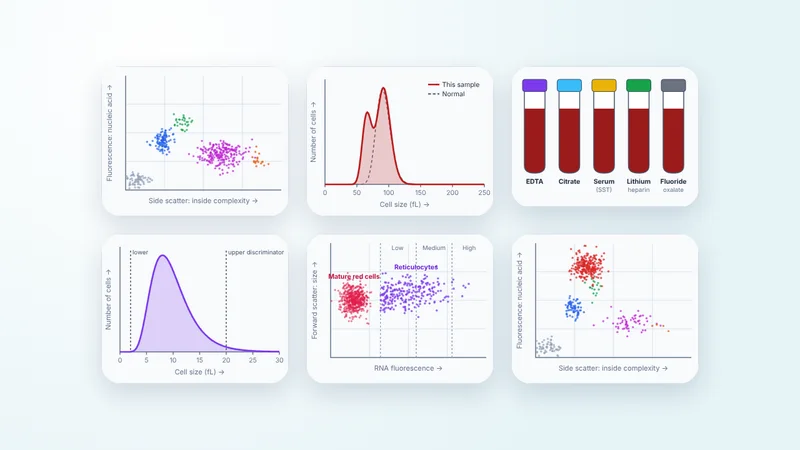
Only Cells course · Laboratory skills
Count, Check, Act
Reading the full blood count
Read a full blood count with confidence: know where each number comes from, check whether it can be trusted, recognise the common patterns and decide what to do next. For anyone who validates, reports or acts on blood counts.
- 14 modules
- 55 interactive lessons
- Workbook (PDF)
- Certificate
What you will be able to do
- Explain why EDTA whole blood is the sample for a full blood count, and how the tube, filling, mixing, age and storage change the results
- Describe how analysers count and size cells, and read histograms, scattergrams and flags
- Say what each parameter means and whether it is measured or calculated
- Apply reference ranges correctly, allowing for age, sex, pregnancy and ancestry, and use your laboratory's ranges and critical limits
- Recognise a result that is likely to be wrong, find the cause and take the right action before it is released
- Recognise the full blood count patterns of the common anaemias, reactive white cell changes, blood cancers, platelet disorders and pancytopenia, and the changes in pregnancy, newborns and children, liver disease, alcohol and kidney disease
- Choose the next investigation and explain what it confirms or rules out
- Describe, comment and escalate within your role and your laboratory's policy, including urgent and critical results
What’s in the course
14 modules and 55 lessons, with an assessment at the end of each module and a final assessment. Your certificate records the learning time you actually spend, for your CPD record.
Module 1: The sample4 lessons
Every full blood count starts with a tube of blood. If the tube is wrong, under-filled, clotted, old or taken from the wrong place, no analyser can rescue the result. This module covers why the full blood count is done on EDTA whole blood, how to collect and handle the sample well, what happens as it ages, and when to accept or reject it.Module 2: Inside the analyser5 lessons
A haematology analyser counts and sizes tens of thousands of cells in under a minute. Knowing how it does this explains most of the strange results you will meet: why giant platelets go missing, why a milky sample has a high haemoglobin, and what a flag is really telling you. Manufacturers use different methods; this module describes the main principles without favouring any one of them.Module 3: The red cell numbers4 lessons
Seven of the numbers on a full blood count describe the red cells. Some are measured and some are calculated from the others, and knowing which is which helps you spot a result that cannot be right. This module covers haemoglobin, red cell count, haematocrit, the red cell indices, the RDW and reticulocytes.Module 4: White cell and platelet numbers3 lessons
The white cell count and differential tell you about infection, inflammation, allergy and blood cancers; the platelet count about bleeding and clotting risk. This module covers why absolute counts matter more than percentages, what the analyser cannot classify, how nucleated red cells affect the white count, and what the platelet count, MPV and immature platelet fraction can and can't tell you.Module 5: Reference ranges and normal variation4 lessons
A result is only high or low compared with something. This module explains what a reference range is and what it is not, and how normal values change with age, sex, pregnancy, ancestry and everyday factors such as smoking and exercise. The ranges shown are examples for teaching: always use your own laboratory's ranges.Module 6: Can I trust this result?4 lessons
Before you interpret a full blood count, ask whether it can be right. This module comes before the disease patterns on purpose. It covers the sample problems and analyser interferences that produce believable but wrong results, how to use previous results as a check, and a routine to follow before you re-run or release a doubtful result.Module 7: Anaemia I: small red cells3 lessons
Small, pale red cells are the commonest abnormal red cell finding in UK laboratories. Most are due to iron deficiency or thalassaemia trait, and telling them apart matters: one needs iron and a search for the cause, the other needs no iron but may matter for a pregnancy. This module covers iron deficiency, thalassaemia trait, anaemia of inflammation and the rarer causes.Module 8: Anaemia II: large cells, haemolysis and bleeding4 lessons
This module covers anaemia with large red cells (macrocytosis), red cells destroyed early (haemolysis), blood loss, and anaemia with normal-sized cells. In each, the MCV and the reticulocyte count are the two numbers that point you towards the cause.Module 9: White cells: reactive patterns4 lessons
Most abnormal white counts are the body reacting to something: infection, inflammation, allergy, a drug or stress. This module covers the common reactive changes in each white cell type, the low counts that are urgent, and the clues that point away from a reactive cause towards a blood cancer.Module 10: Blood cancers and the FBC5 lessons
Many blood cancers are first suspected from a full blood count, often one requested for something else. This module covers the patterns of acute leukaemia, chronic lymphocytic leukaemia, chronic myeloid leukaemia, the myeloproliferative neoplasms and erythrocytosis, and the clues to myelodysplasia, myeloma and marrow infiltration. Diagnosis is always made by specialists using further tests; the laboratory's job is to recognise the pattern and act quickly.Module 11: Platelets and pancytopenia4 lessons
A low platelet count can be an artefact, a harmless finding, or the first sign of an emergency such as thrombotic thrombocytopenic purpura or malaria. A high count is usually reactive but can be a myeloproliferative neoplasm. This module also covers pancytopenia, when all three cell lines are low.Module 12: Special situations4 lessons
The same numbers mean different things in different people. This module covers the full blood count in pregnancy, in newborn babies and children, in liver disease and heavy alcohol use, and in kidney disease.Module 13: What to do next4 lessons
A full blood count rarely gives a diagnosis on its own. Its value is in pointing to the right next test. This module covers when to make a blood film, the follow-up tests for red cell problems, the wider tests that help, and the specialist tests used to diagnose blood cancers, with what each one can confirm or rule out.Module 14: Your role: comment, escalate, put it together3 lessons
Reading a count is only useful if the right person hears about it, in the right words, at the right speed. This module covers what you can say on a report within your role, how to handle urgent and critical results, and a routine for reading any full blood count from start to finish.
Educational use: a training course for laboratory staff and students. Always follow your laboratory’s procedures and current national guidance.